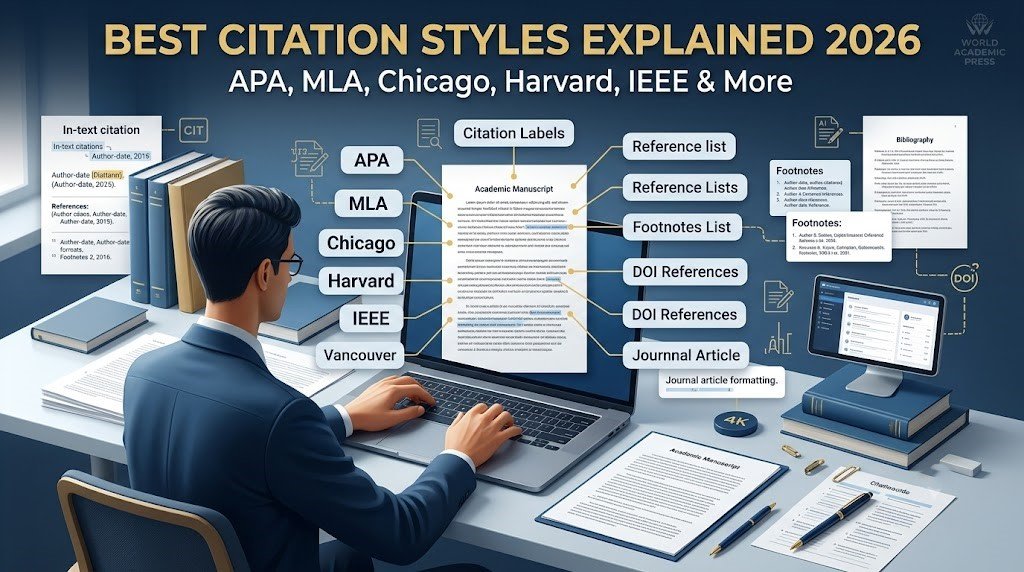
Best Citation Styles Explained in 2026
Citation styles are one of the most important foundations of academic writing. Whether you are preparing a research paper, thesis, dissertation, literature review, journal article, or conference submission, accurate referencing helps you give proper credit, avoid plagiarism, improve credibility, and meet university or publisher requirements. In 2026, citation practices are evolving alongside digital publishing, AI-assisted research tools, and updated style manuals, making it even more important for scholars to understand the major citation systems correctly.
Many students and early-career researchers struggle with one key question: which citation style should I use, and how do I apply it correctly? The answer depends on your academic discipline, institution, target journal, and the type of source you are citing. This guide explains the best citation styles in 2026, how they differ, and when each one is typically used in academic research.
Why Citation Styles Matter in Academic Research
Citations do far more than fill a references page. They show where your ideas, data, theories, and evidence come from. Proper citation helps readers verify your claims, follow your research trail, and evaluate the scholarly depth of your work. It also protects you from accidental plagiarism and demonstrates professionalism in academic communication.
In 2026, citation quality matters even more because academic publishing is increasingly digital, cross-disciplinary, and global. Scholars are citing not only books and journal articles but also datasets, preprints, software, websites, online reports, AI-assisted tools, and multimedia materials. Using the correct citation style ensures your work remains consistent and credible across these formats.
If you are still building your paper, it may also help to review How to Structure a Research Paper Correctly 2026 so your references fit smoothly into a strong academic framework.
APA Style (7th Edition)
APA, developed by the American Psychological Association, remains one of the most widely used citation styles in 2026. It is especially common in psychology, education, business, social sciences, communication studies, and many interdisciplinary research areas.
APA uses an author-date in-text citation format, such as (Sharma, 2026), and a detailed reference list at the end of the paper. It emphasizes publication year because recent evidence is particularly important in many social science and behavioral research fields.
APA is best for:
- Psychology and behavioral sciences
- Education research
- Business and management studies
- Social sciences and communication research
- Health sciences in some contexts
Why researchers choose APA:
- Clear in-text citations
- Strong support for journal articles, online sources, and DOIs
- Widely accepted by universities and journals
- Updated guidance for digital and online references
APA is often the easiest style for researchers who cite recent journal articles heavily and want a modern author-date system.
MLA Style (9th Edition)
MLA, developed by the Modern Language Association, is commonly used in literature, language studies, humanities, cultural studies, and some arts-related disciplines. Instead of an author-date format, MLA uses author-page in-text citations such as (Roy 42).
MLA is especially useful when close textual analysis matters and page numbers are central to the discussion, which is often the case in literary criticism and humanities writing.
MLA is best for:
- English literature
- Comparative literature
- Language and cultural studies
- Humanities essays and textual analysis
- Some media and performance studies
Why researchers choose MLA:
- Strong for quoting and analyzing texts
- Simple author-page citation structure
- Common across humanities departments
- Flexible for books, poems, films, and digital media
If your work is focused on interpreting texts rather than reporting empirical results, MLA is often a better fit than APA.
Chicago Style
Chicago style remains a major citation system in 2026, especially in history, some humanities fields, and certain publishing contexts. It actually offers two systems: the Notes and Bibliography style and the Author-Date style.
The Notes and Bibliography system uses footnotes or endnotes plus a bibliography, making it ideal for disciplines where source discussion, archival references, and commentary are important. The Author-Date version is more similar to APA and is used in some sciences and social sciences.
Chicago is best for:
- History
- Art history
- Theology and philosophy in some institutions
- Book publishing and long-form academic manuscripts
- Research that benefits from detailed source notes
Why researchers choose Chicago:
- Excellent for archival and historical sources
- Footnotes allow additional explanation without cluttering the main text
- Highly flexible for books, manuscripts, and complex source types
- Well suited to monographs and scholarly books
Harvard Referencing
Harvard referencing is another author-date style widely used across universities in the UK, Australia, India, and many international academic institutions. Unlike APA, Harvard does not have a single official manual, so universities and publishers often adapt it with their own formatting preferences.
This flexibility is both an advantage and a challenge. It makes Harvard widely usable across disciplines, but scholars must always check the exact institutional guide they are expected to follow.
Harvard is best for:
- General university assignments
- Interdisciplinary research
- Business, economics, and social sciences
- Institutions that use custom referencing guides
- Researchers who need a straightforward author-date system
Why researchers choose Harvard:
- Easy to read in-text citations
- Common in international higher education
- Works well for books, articles, reports, and online sources
- Flexible across multiple disciplines
IEEE Style
IEEE is a numbered citation style commonly used in engineering, computer science, electronics, telecommunications, robotics, and technical research. Instead of citing authors in the text, IEEE uses numbered references in square brackets, such as [4].
Because engineering papers often contain many references and technical data points, IEEE keeps the text cleaner and more compact than author-date systems.
IEEE is best for:
- Electrical engineering
- Computer science
- Electronics and communications
- Technical conference papers
- STEM research with dense citation needs
Why researchers choose IEEE:
- Compact citation style for technical writing
- Common in conference proceedings and engineering journals
- Works well with multiple sources in one sentence
- Widely supported by technical publishers
Vancouver Style
Vancouver is another numbered citation style used primarily in medicine, biomedical sciences, clinical research, and health sciences. It is especially common in journal submissions related to medical publishing.
Like IEEE, Vancouver uses numbers in the text, but its formatting conventions are aligned with biomedical publishing standards.
Vancouver is best for:
- Medicine and clinical research
- Public health and biomedical sciences
- Nursing and allied health disciplines
- Medical journal submissions
Which Citation Style Should You Use?
The best citation style depends on four main factors:
- Your academic discipline – humanities, engineering, medicine, and social sciences often use different systems.
- Your university’s formatting requirements – some institutions mandate Harvard, APA, or MLA regardless of discipline.
- Your target journal or publisher – always check the journal’s author guidelines before submission.
- The kinds of sources you use most – historical archives, technical conference papers, and clinical studies may require different citation conventions.
As a general rule:
- Use APA for social sciences, education, and many interdisciplinary studies.
- Use MLA for literature and humanities.
- Use Chicago for history and footnote-heavy scholarly work.
- Use Harvard when your institution or region prefers a flexible author-date style.
- Use IEEE for engineering and computer science.
- Use Vancouver for medicine and health sciences.
Citation Challenges in 2026
Researchers today cite more than traditional books and journal articles. Common citation challenges now include:
- How to cite AI-assisted tools and outputs where allowed
- How to reference preprints and working papers
- How to cite datasets, code repositories, and software
- How to handle DOI formatting and online-first journal articles
- How to cite digital media, webinars, and online conference materials
This is why scholars should always use the latest edition of the style guide or the journal’s most recent instructions. Outdated citation templates can cause avoidable formatting errors during submission.
If you are using digital tools to manage sources, our guide on AI Tools for Academic Research and Writing 2026 can help you combine citation management with faster research workflows.
How to Avoid Citation Mistakes
Even experienced researchers make referencing errors. The most common mistakes include inconsistent punctuation, missing page numbers, incorrect capitalization, broken URLs, incomplete author names, and mixing citation styles in the same manuscript.
To avoid these issues:
- Choose your citation style before you start writing.
- Use reference managers like Zotero, Mendeley, or EndNote carefully.
- Double-check every automatically generated citation.
- Keep a clean record of all sources during your literature review.
- Review the target journal’s author guidelines before final submission.
Researchers who want to improve overall manuscript quality should also read Common Research Writing Mistakes to Avoid and Research Ethics Every Scholar Must Follow in 2026, since accurate citation is directly tied to academic integrity.
Conclusion
The best citation style in 2026 depends on your discipline, institution, journal target, and source types, but the principle behind every style is the same: give clear, consistent, and accurate credit to the work that supports your research. APA, MLA, Chicago, Harvard, IEEE, and Vancouver each serve different academic needs, and understanding their purpose can save you time, reduce errors, and strengthen the credibility of your manuscript.
As academic publishing continues to evolve, citation literacy remains a core research skill. Scholars who understand referencing properly are better equipped to publish, collaborate, and build trustworthy academic work in any field. For more practical guidance on writing, publishing, and research strategy, explore additional resources at World Academic Press.