Sociology of Education
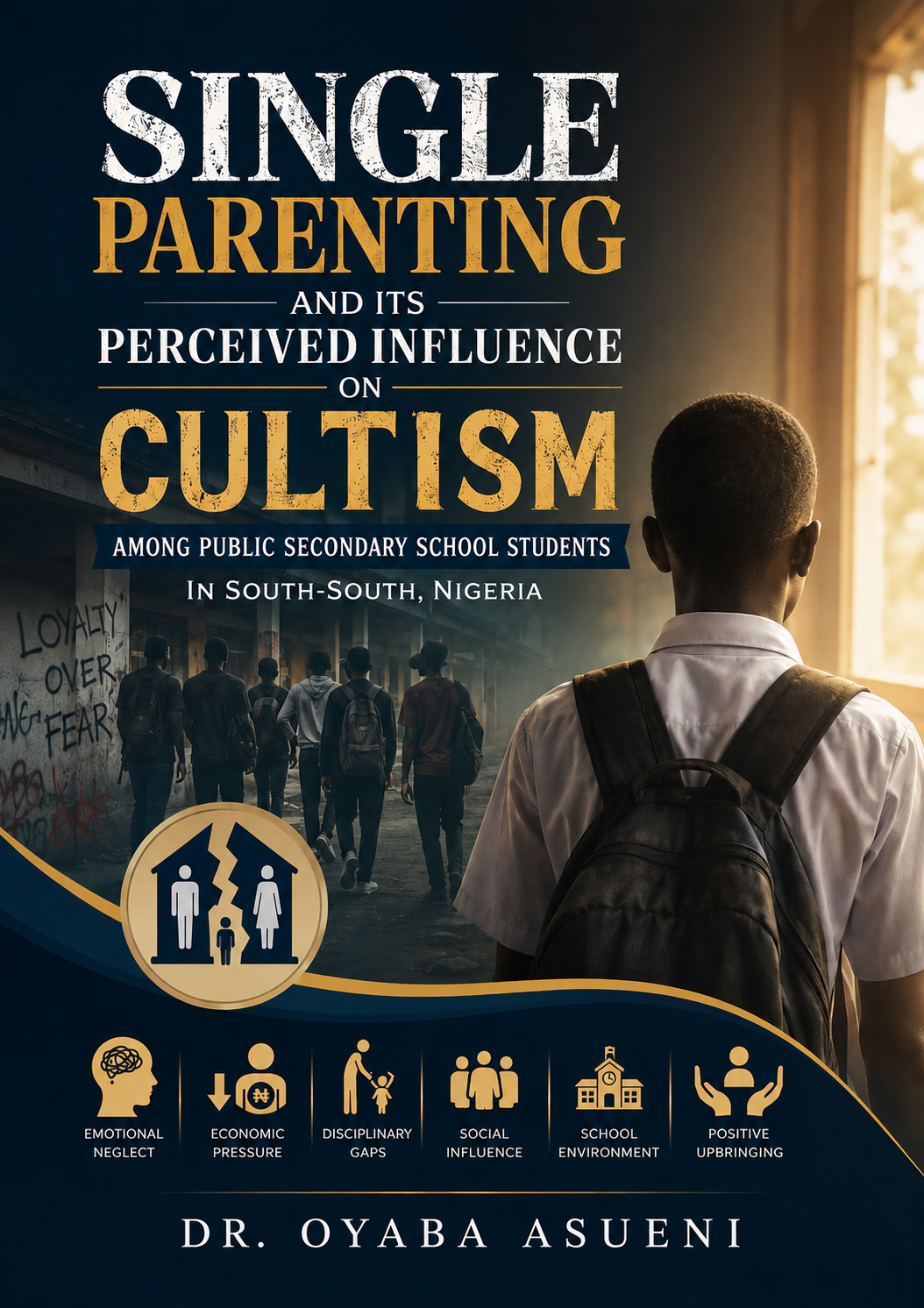
SINGLE PARENTING AND ITS PERCEIVED INFLUENCE ON CULTISM AMONG PUBLIC SECONDARY SCHOOL STUDENTS IN SOUTH-SOUTH, NIGERIA
AUTHOR:
DR. OYABA ASUENI
DATE ISSUED:
Aug 2026
READ:
SUBJECT:
Educational Psychology, Family Studies, Youth & Adolescent Behaviour
JEL CODE:
EDU009000
LANGUAGE:
English
ISBN:
978-81-689626-9-9
₹140₹980
Digital Edition
Instant PDF Delivery
₹140
Print Edition
Global Shipping
₹670
Description
Cultism in Nigeria began as a university affair. It has since worked its way down into the secondary school, and in the South-South it now surfaces at inter-house sports fixtures, in supremacy clashes between rival groups, and in killings that reach well beyond the school gate. Why some students are drawn into it while others are not is the question this book sets out to answer — and it looks for part of that answer inside the home.
Dr Oyaba Asueni surveys 720 students from single-parent families, drawn from 72 public secondary schools across Akwa Ibom, Bayelsa, Cross River and Delta States, out of a population of 56,880. Using a purpose-built instrument, the Single Parenting and Cultism Questionnaire, with a reliability index of 0.87 on Cronbach's alpha, the study puts four hypotheses to the test at the 0.05 level of significance.
Three findings carry the book. Students judge single parenting to exert a negative influence capable of carrying them toward cult activity. Social engagement — friendships, participation in school life, somewhere to take a problem — works in the opposite direction, discouraging that involvement. And upbringing proves decisive in both directions: neglect opens the door, while attentive parenting closes it. On the first of these, male and female students did not differ significantly in opinion; on the others, they did.
What distinguishes the work is its refusal to turn a finding into an accusation. Single parenthood is examined as a structure carrying identifiable pressures — economic, emotional, disciplinary — rather than as a moral failing, and the argument is set within rational choice, social control, family deficit and parental attachment theory before any recommendation is offered. Those recommendations are practical: orientation for new intakes, sustained counselling for children of single-parent homes, firmer institutional sanction against cult involvement, and policy that supports single parents rather than merely naming them.
Written for school administrators, guidance counsellors, policymakers, sociologists of education and parents, the book addresses a gap its author states plainly: no earlier study had connected single parenting to cultism in secondary schools in this region. Where there had been assumption, it puts evidence.
Secure Payment
Protected Transactions
Instant Access
Digital PDF Ready
World-Wide
Global Shipping
Support
24/7 Author Assistance